Behind on your books? A catch-up bookkeeping plan for BC businesses
Months or years behind? What catch-up bookkeeping involves, what late GST/HST and T2 filing really costs, the order to do it in, and how to stay current after.
In short
- Late GST/HST returns cost 1% of the amount owing plus 0.25% for each full month late, up to 12 months, plus daily compound interest. No penalty if you owe nothing.
- Late T2 corporate returns cost 5% of unpaid tax plus 1% a month, up to 12 months, and more for repeat late filers.
- Catch up in order: gather statements, reconcile bank and cards, add sales and bills, fix sales tax, then file the oldest returns first.
- Keep records for six years. Once you are current, a monthly routine keeps you there.
Falling behind on bookkeeping is common, and fixable. A busy season, a bookkeeper who left, a move to new software: a few months slip, then a GST return is due and nobody is sure the numbers are right. This guide explains what catch-up bookkeeping involves, what being late actually costs with the CRA and the BC government, and a practical order of work that gets you current without making things worse.
What catch-up bookkeeping means
Catch-up bookkeeping is bringing your books up to date for the months or years that were missed, so every bank and card transaction is recorded, matched and reconciled, and your sales tax and income tax returns can be filed on numbers you trust. Clean-up is related but different: it fixes books that were kept, but kept wrong. Most backlogs need a bit of both.
What being late costs
The CRA's GST/HST late-filing penalty is 1% of the amount owing, plus 25% of that 1% for each complete month the return is late, up to 12 months (CRA). It applies only if you owe tax: a late return that shows a refund or zero owing has no penalty. Interest is charged separately on unpaid tax and penalties, compounded daily.
Complete months late
Penalty on $10,000 owing: $100 in the first month, rising by $25 each complete month to a maximum of $400 at 12 months.
For corporations, a late T2 return costs 5% of the tax unpaid at the filing deadline, plus 1% of it for each complete month late, up to 12 months. Repeat late filers can face 10% plus 2% a month, up to 20 months (CRA). On $10,000 of unpaid tax, a year late, the first-time penalty is $1,700 before interest.
BC PST returns are due on the last day of the month after your reporting period. Late filing and payment can bring penalties, interest and the loss of the commission you would otherwise keep, although the Province may send a warning letter the first time if you have a good record (BC Ministry of Finance, Bulletin CTB 005).
The order that works
- 1GatherStatements, sales, bills
- 2ReconcileEvery bank and card
- 3RecordSales and bills matched
- 4Fix taxGST and PST codes
- 5FileOldest first
- Gather. Download every bank, credit card, loan and payment processor statement for the missing months (Stripe, Square, PayPal, Shopify Payments). Export sales and invoices from your sales system. Collect supplier bills and receipts.
- Reconcile. Bring every bank and card account up to date and reconcile it to the statement balance, month by month. Nothing else is reliable until this is done.
- Record sales and bills. Match deposits to sales and invoices, and payments to bills. Record what is still owed to you and what you owe.
- Fix sales tax. Check that GST and PST are on the right codes, that input tax credits are supported by bills, and that each return period adds up.
- File, oldest first. File the overdue GST/HST and PST returns from the oldest period, then year-end and income tax with your accountant.
Records the CRA expects
You need records that support every number on your returns. For input tax credits, the CRA sets the detail by purchase size (CRA):
| Purchase total | What the record must show |
|---|---|
| Under $100 | Supplier's name, invoice date, total amount |
| $100 to $499.99 | Also the GST/HST charged (or that it is included) and the supplier's GST/HST number |
| $500 or more | Also your business name, a description of what you bought, and the payment terms |
A bank statement line on its own is not enough to claim an ITC. Keep records for six years from the end of the tax year they relate to.
How long a catch-up takes
It depends far more on volume and condition than on the number of months. Twelve months of a simple consulting business with one bank account can be a few days of work. Six months of a busy retailer with cash sales, two card processors and PST can take weeks. The things that slow it down are missing statements, payment processors that deposit sales net of fees, personal spending mixed into the business account, and software that was set up with the wrong tax codes.
Special situations
- Missing statements. Banks and card issuers can provide past statements; ask early, because some charge for older ones or take time.
- Payment processors. Stripe, Square and Shopify deposit sales after fees, sometimes combined across days. Record the gross sale, the fee and the deposit separately, or your sales and GST will be understated.
- Cash sales. Rebuild them from your point-of-sale reports, not from what reached the bank.
- Letters from the CRA. If the CRA has written about a missing return, do not ignore it. Respond, and talk to your accountant about the best order to file. If you need to correct past returns that were wrong, ask them about the CRA's options for doing so.
- Software you no longer use. Export everything before a subscription ends. You need the records for six years.
Doing it yourself, or getting help
A short backlog in simple books is manageable on your own: set aside time each week, follow the order above, and do not file until the bank reconciles. Get help when the backlog is longer than a few months, when you collect both GST and PST, when you have payroll, or when you are not sure the numbers already in the software are right.
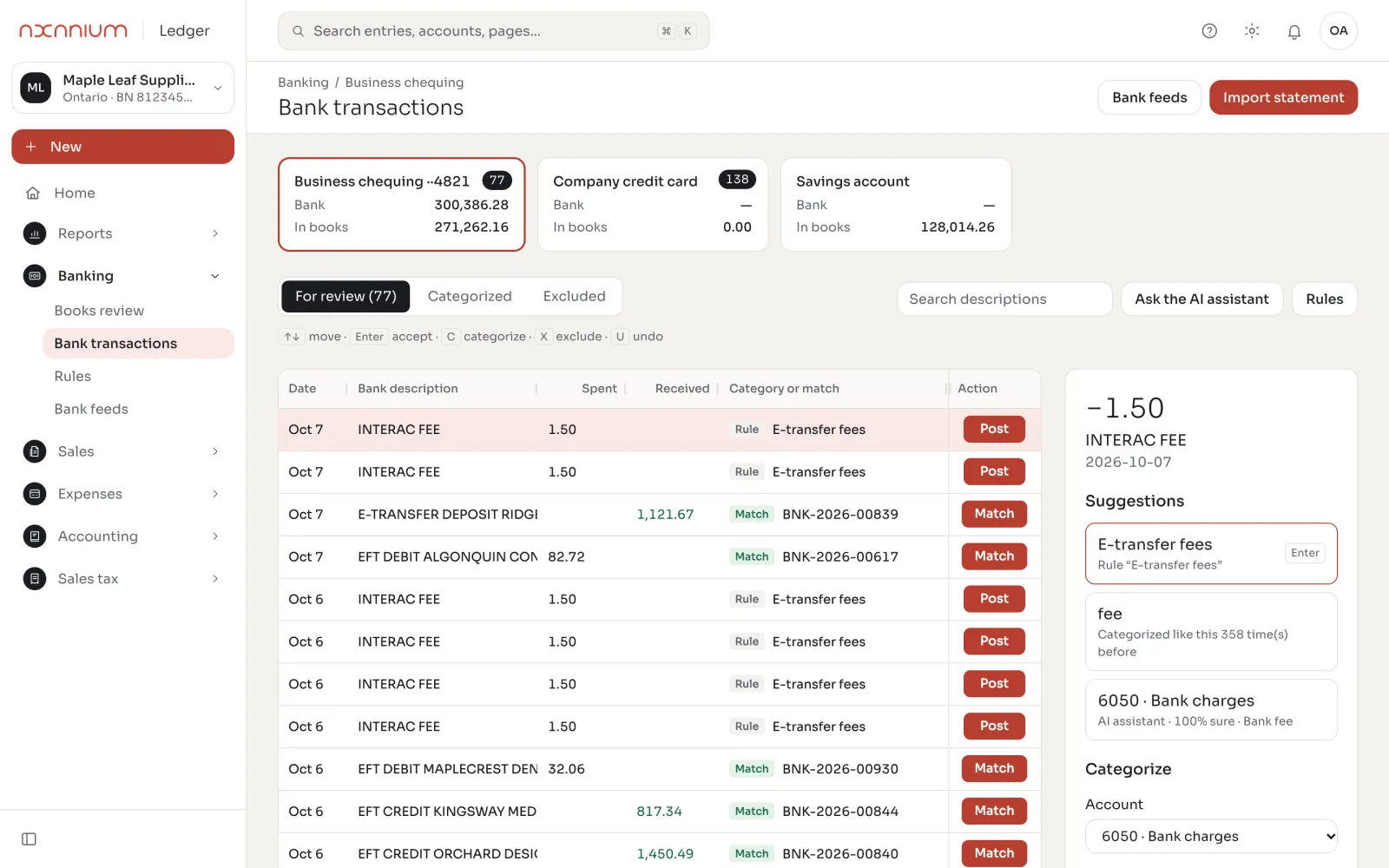
Ask any provider for a fixed price per month of backlog before work starts, what they need from you, and the order they will file in. Most of the time is spent on the reconciliation, so a provider who matches bank lines to your history quickly will finish faster. That is where AxLedger helps: it matches lines to past entries and rules, and suggests the rest with a confidence score, for a bookkeeper to check.
Staying current afterwards
- Reconcile bank and cards every month, within a couple of weeks of month-end.
- Forward bills and receipts as they arrive, not at tax time.
- Put each GST/HST and PST due date in your calendar, or let your bookkeeper own them.
- Close each month: once it is reviewed, lock the period so numbers cannot change by accident.
Questions
What is catch-up bookkeeping?
Bringing your books up to date for missed months or years, so every transaction is recorded and reconciled and your returns can be filed on reliable numbers.
What is the penalty for filing a GST/HST return late?
1% of the amount owing plus 0.25% of it for each complete month late, up to 12 months, plus interest. There is no late-filing penalty if the return shows a refund or nothing owing.
Which returns should I file first?
Reconcile first, then file the oldest overdue GST/HST and PST returns, then year-end and income tax returns.
How long do I have to keep business records in Canada?
Generally six years from the end of the last tax year they relate to.
Sources
Want this handled for you?
Axanium is an AI-native services company for accounting and bookkeeping, based in Vancouver, BC. Book a 20-minute call and get a fixed monthly price.
Get a free books health check