AI in accounting: how Canadian businesses are using it in 2026
How AI is used in accounting and bookkeeping in Canada in 2026: what it automates, where people still decide, privacy and CRA record keeping, and how to start.
In short
- About one in five Canadian businesses used AI to produce goods or deliver services in the year to mid-2026, roughly three times the share two years earlier, according to Statistics Canada figures reported by The Hub.
- In accounting, AI is best at repetitive data work: categorizing transactions, reading bills and receipts, matching payments and spotting what looks unusual.
- It does not change who is responsible. The business still answers to the CRA for its returns and must keep its records, generally for six years.
- Before you use it, find out where your data goes, whether a person reviews what the AI suggests, and whether every decision is logged.
Where AI shows up in accounting today
- Categorizing bank and card transactions, with a suggested account and how sure it is
- Reading supplier bills and receipts from PDFs and photos into draft entries
- Matching payments to the invoices and bills they settle
- Flagging what looks unusual: possible duplicates, payments without an invoice, amounts out of pattern
- Drafting the first version of a month-end note or answering questions about the books
Most of this used to be typing and checking by memory. The useful change is that a person now reviews suggestions instead of entering everything, which is faster and leaves a record of who decided. For a plain definition, see What is AI accounting?
How much Canadian businesses use it
Statistics Canada's Canadian Survey on Business Conditions found that about 19% of businesses used AI to produce goods or deliver services in the twelve months to the second quarter of 2026, up from about 6% in 2024, as reported by The Hub. Finance and insurance were among the heaviest users, at about 40%.
What AI does not change
- You are responsible for your GST/HST, PST and income tax returns, whoever or whatever prepared them.
- Records have to be kept, generally for six years from the end of the tax year they relate to (CRA).
- Judgement calls stay with people: the tax treatment of an unusual item, an estimate at year-end, what to tell your lender.
The risks, and how to manage them
| Risk | What it looks like | The control |
|---|---|---|
| Confident but wrong | An expense coded to the wrong account, or the wrong tax claimed | A person reviews every suggestion; the AI says how sure it is |
| Data leaving Canada | Bank lines and documents sent to an AI service abroad | Know which providers process what, and where. Privacy law: PIPEDA |
| No trail | Nobody can say why an entry was made | A log of which rule, history, AI suggestion or person decided |
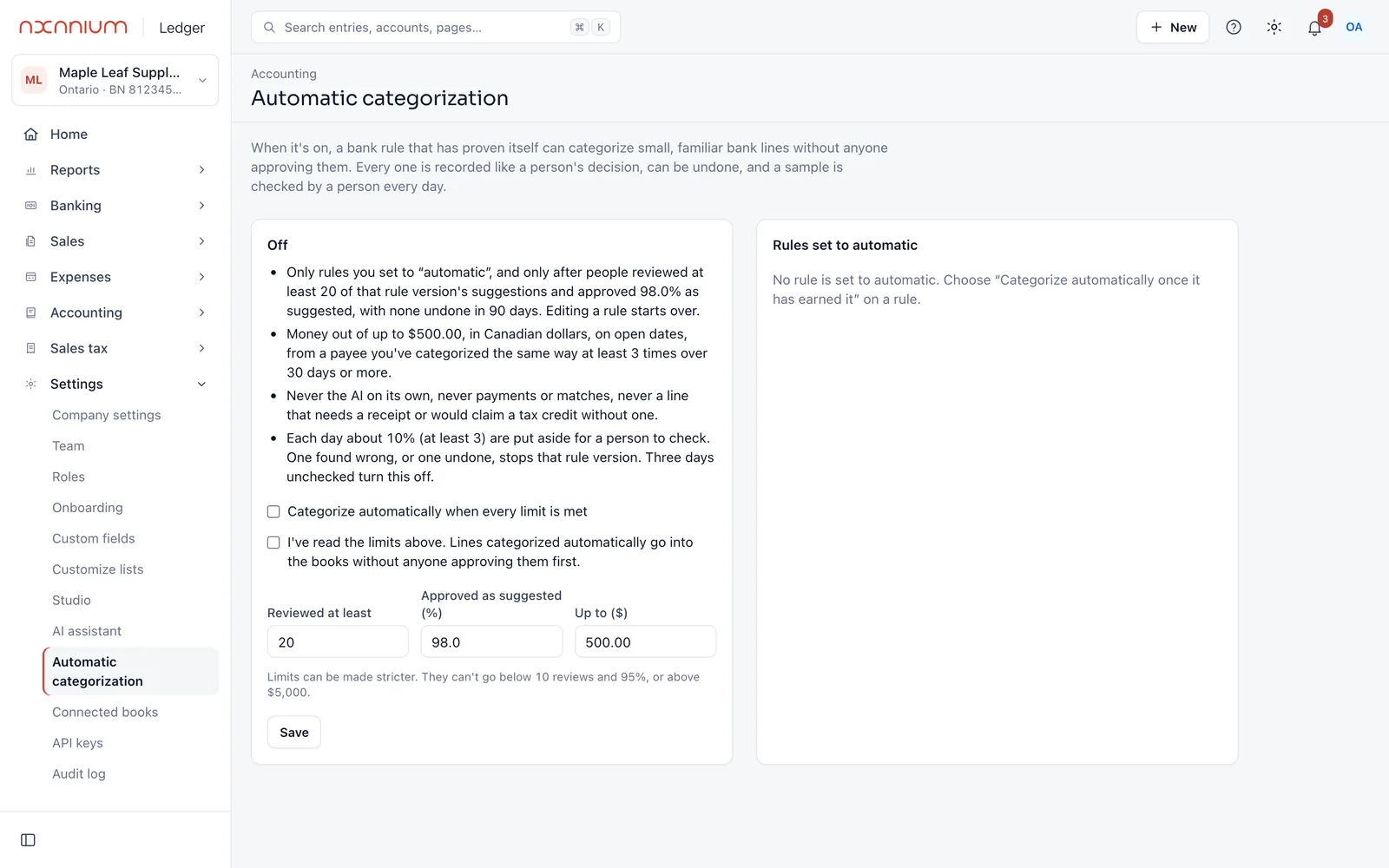
| Automation that posts on its own | Errors reach the books before anyone looks | Nothing posted without a person, or strict limits that are checked |
How to start
- Get your books current first: AI suggestions learn from clean history
- Start with one task, usually bank categorization or reading bills
- Keep a person approving every entry for the first months
- Check where your data is stored and processed
- Measure: how often suggestions are accepted, changed or undone
Choosing software or a service? Our AI bookkeeping buyer's guide lists ten questions to ask, and the accounting software comparison covers prices.
Questions
How is AI used in accounting?
Mostly for repetitive data work: categorizing transactions, reading bills and receipts, matching payments and flagging unusual items, with people reviewing the results.
Will AI replace accountants and bookkeepers?
It replaces typing, not judgement. Someone still has to review entries, close the month, prepare returns and answer for them.
Is it safe to use AI with financial data in Canada?
It can be, if you know where the data is stored and processed, the provider is bound by contract, and a person reviews what the AI produces. PIPEDA governs personal information in most private businesses.
What is AI accounting software?
Accounting software that uses AI to suggest entries, read documents and spot problems. Good examples show how sure they are and let a person decide.
Sources
Want this handled for you?
Axanium is an AI-native services company for accounting and bookkeeping, serving businesses across Canada online. Get a fixed monthly price.
Get a free books health check